

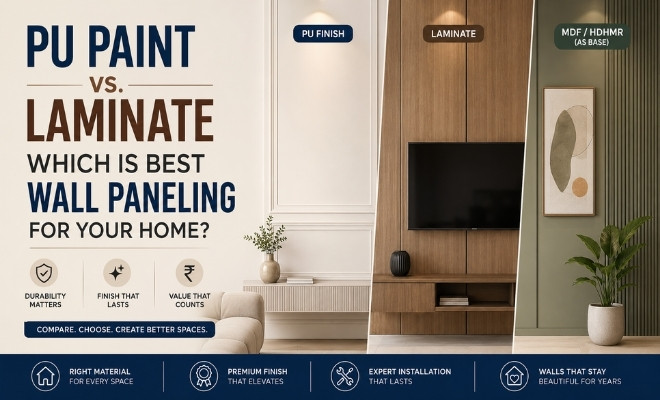
wall panelling
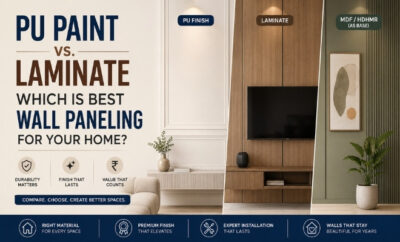
PU Paint vs. Laminate : Which Is Best Wall Paneling for Your Home?
Wall paneling is one of those decisions that looks simple on the surface and quietly shapes your home for years. Once it’s installed, you live with it every single day. You clean it, bump into it, notice how it ages, and eventually judge whether it was a good call or not.
The confusion usually starts with materials, whether to go with PU or laminate. They’re often discussed, as if they’re interchangeable, but they behave very differently over time. Choosing the wrong one doesn’t always fail immediately. It fails slowly. Corners chip, surfaces dull, joints open up, or moisture starts doing damage, you can’t undo without rework.
So let’s break this down properly, based on performance, not brochures.
What exactly is PU Paneling?
PU (Polyurethane) Paint is a finish, not a board. It’s applied over a base, most commonly MDF/HDHMR, to create a sealed, uniform surface. PU is highly application-sensitive, and the final result depends entirely on surface preparation, coating thickness, and proper curing. When execution is rushed or inconsistent, issues like cracking, uneven sheen, or yellowing show up over time. In short, PU rewards skilled workmanship, and any shortcuts become visible sooner rather than later.
Why people choose PU
- Smooth, seamless appearance with no visible grain
- Excellent resistance to stains and surface moisture
- Slower visual ageing when applied correctly
- Easy day-to-day cleaning
Where PU works best
- Living room feature walls
- TV units and backdrop panels
- Bedrooms and low-impact zones
What is laminate paneling?
Laminate is a factory-finished decorative sheet bonded onto a board surface. It’s widely used because it’s predictable and durable. Laminate panels have visible joints and edges. Once damaged, repairs are difficult, and you usually replace the panel rather than fix it. Therefore, this material prioritizes durability over visual continuity
Why laminate is popular
- High resistance to scratches and daily wear
- Consistent finish straight from the factory
- Large range of colors and textures
- Faster installation and controlled cost
Where laminate works best
- High-traffic areas
- Kids’ rooms
- Commercial or rental spaces
What about MDF/HDHMR paneling?
MDF /HDHMR is the core material, not a finish. It’s the base that gets painted, laminated, or PU-coated. Raw MDF is vulnerable to moisture and can swell or weaken if left unsealed. Its long-term performance depends entirely on how well it’s finished and installed, making detailing and edge protection critical rather than optional.
Why MDF/HDHMR is widely used
- Smooth, even surface for finishes
- Easy to groove, flute, and customize
- Cost-effective compared to solid wood
- Stable and knot-free
Where MDF/HDHMR works best
- Decorative wall panels
- Fluted or grooved designs
- Painted or PU-finished applications
PU vs. Laminate vs. MDF: clear comparison
| Aspect | PU Finish | Laminate | MDF/HDHMR (as base) |
|---|---|---|---|
| What it is | A coating applied over MDF/HDHMR | Decorative sheet bonded to board | Core board material |
| Visual finish | Seamless, premium, uniform | Clean but jointed | Not meant to be exposed |
| Durability | High surface protection | High impact resistance | Depends on finish |
| Moisture resistance | Good when sealed properly | Very good | Poor without sealing |
| Maintenance | Low, gentle cleaning | Very low | Depends on finish |
| Repairability | Possible but skill-dependent | Usually requires replacement | Not applicable alone |
| Cost range | Premium | Mid-range | Affordable base |
Which one should you choose?
Instead of asking “which material is best,” ask what the wall needs to survive.
- If the space demands visual calm, clean lines, and a refined finish that holds up over time, PU-finished paneling makes sense. It works especially well where aesthetics matter more than impact resistance.
- If the wall will see constant use, accidental hits, or frequent cleaning, laminate paneling is the safer, tougher option. It may not look seamless, but it takes daily life well.
- If your design involves grooves, flutes, or custom patterns, MDF/HDHMR is the right foundation, provided it’s sealed and finished correctly.
Final takeaway: materials matter, execution matters more
PU, laminate, and MDF/HDHMR all have a place in modern homes. The right choice is the one that aligns with how the space is used, how much wear it sees, and how long you expect it to look good without constant fixes.
This is where experienced planning makes all the difference. Nexus Interio approaches wall panelling as a long-term system, not just a surface upgrade, balancing material choice, finish quality, and installation precision.
If you’re considering paneling- Specially P.U finish with cnc design for your home and want clarity before committing, connect with Nexus Interio to plan walls that stay solid, clean, and visually consistent for years to come.





0 comments